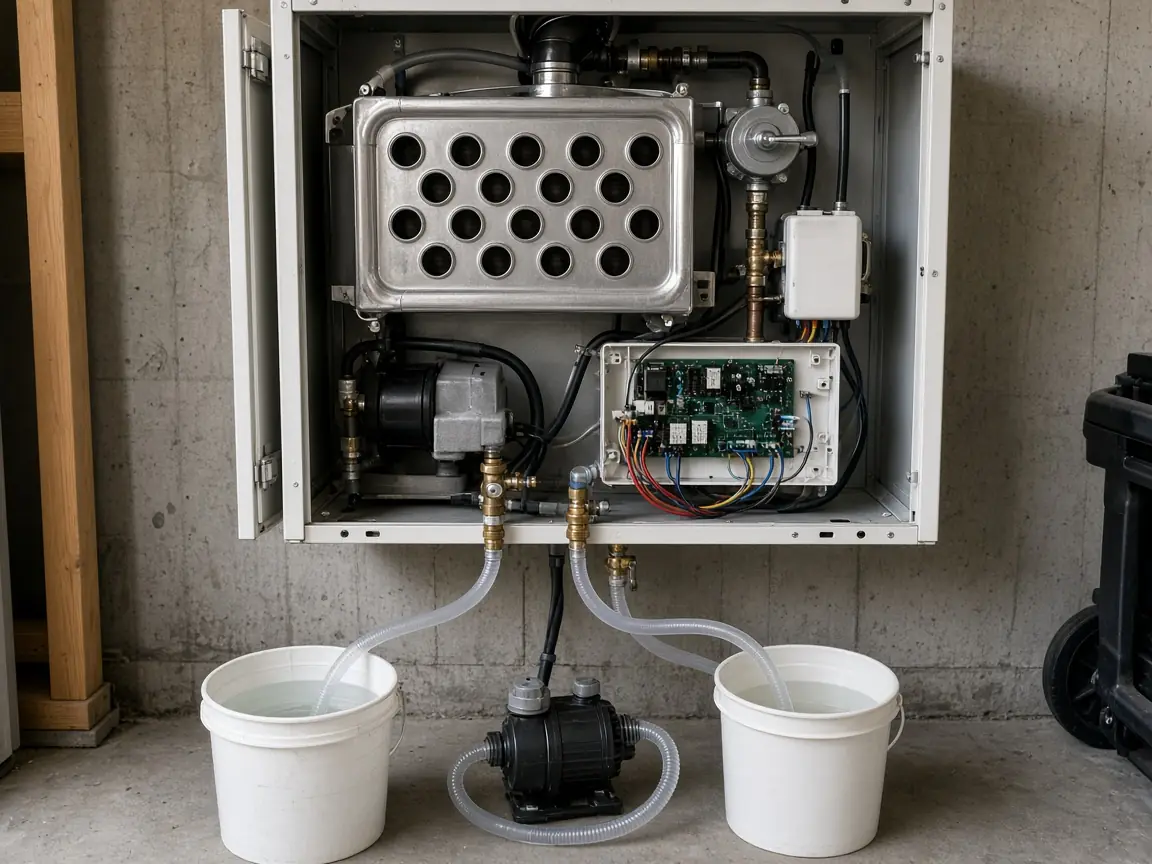
Descale a tankless water heater in Portland, OR on the manufacturer's schedule, typically every one to two years on soft Bull Run water and more often on harder well or groundwater. Descaling circulates a mild acid solution through the heat exchanger using a small pump connected to the unit's service valves. Overheat codes, temperature swings, and reduced flow are signs it is overdue.
Tankless water heaters heat water as it flows through a compact heat exchanger. Minerals that come out of solution when water is heated stick to those narrow passages. Over time, scale reduces heat transfer, raises internal temperatures, and triggers error codes.
Portland water and scale
Much of Portland gets soft water from the Bull Run supply, so scale builds slowly in city homes, whether in the west hills near Washington Park or the east side. Suburbs on wells or groundwater blends, such as Milwaukie or parts of Gresham, can see faster buildup. The hard water guide explains how supply varies.
Signs scale is building
- Overheat or flow-related error codes.
- Hot water temperature swings at steady flow.
- Reduced maximum flow.
- Unusual noise from the unit.
How descaling works
- Turn off the unit's power and gas, and close the cold and hot isolation valves.
- Connect hoses from a small submersible pump in a bucket to the service ports.
- Fill the bucket with a descaling solution recommended by the manufacturer, often a food-grade acid.
- Circulate for the time specified, often about an hour.
- Flush with clean water, close the service ports, open isolation valves, and restore power and gas.
- Clean the inlet filter.
If your unit lacks isolation valves with service ports, they should be added. Installation without them makes maintenance difficult.
Do it yourself or hire it out?
Many homeowners can descale a unit with valves and a pump kit. If the unit shows codes beyond scale, or if valves are stuck, professional tankless water heater repair is the better choice.
When descaling is not enough
Heavy scale can permanently damage a heat exchanger. If codes persist after descaling, or if the unit is leaking, see tankless water heater replacement.
Prevention
On hard water, scale-reduction cartridges or softeners can extend intervals. Keep a log of descaling dates and results. The anode rods guide covers a related maintenance topic for tanks.
Manufacturer guidance
Warranty coverage can depend on following maintenance schedules. Keep receipts and notes. Energy efficiency programs like Energy Trust of Oregon may also list maintenance tips for efficient units.
A Portland descaling example
Consider a gas tankless unit in a garage in outer Southeast Portland on Bull Run water. After two years, it starts showing occasional overheat codes during long showers. The owner closes the isolation valves, connects a pump kit, and circulates the manufacturer's solution for about an hour. The solution comes back cloudy with fine particles. After flushing and cleaning the inlet filter, the codes stop. On the same unit in a home on well water, the same symptoms might appear in under a year, and the solution might come back with visible flakes of scale.
Common mistakes
- Forgetting to turn off gas and power before connecting hoses.
- Using a solution the manufacturer does not approve, which can damage seals.
- Skipping the clean-water flush, leaving acid in the heat exchanger.
- Leaving service port caps loose, which causes drips later.
- Ignoring the inlet filter, which can restrict flow just as much as scale.
Keeping a log
Write the date, the solution used, circulation time, and how the solution looked afterward. Over a few cycles, the log shows how fast scale builds on your water and lets you adjust the interval up or down with confidence rather than guessing.
Tools you need
A submersible pump rated for the solution, two short washing-machine style hoses, a five-gallon bucket, the descaling solution, towels, and a small brush for the inlet filter. Many hardware stores sell kits with everything except the solution.